
in vitro and in vivo models to study mechanisms, interventions and biomarkers
in metabolic diseases and their complications.
Metabolic Health Research (MHR) at TNO
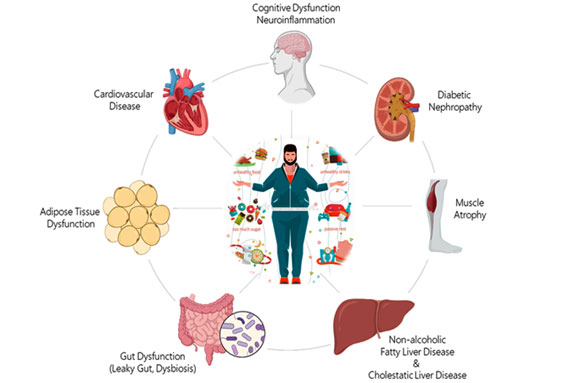
MHR develops and performs in vitro and in vivo models to study mechanisms, interventions and biomarkers in metabolic diseases and their complications.
These translational models include unique (humanized) transgenic mouse models, in vivo and in vitro models, read-out systems employing i.a. histology, biochemical assays, cell biology, molecular biology, immunology and inflammation markers.
This preclinical research is strongly translational and aims to improve the predictability of efficacy and safety of pharmaceutical and food interventions by detailed knowledge of disease processes and mechanisms.
MHR has a track record in applied science, study design, professional project management and quality systems.
MHR offers customized services that can be tailored to customer needs by direct interaction of scientists of MHR and the customer.
We also propose partnering opportunities to gain a deeper understanding of the following points:
● Elucidation of disease mechanisms at the molecular level
● Elucidation of organ cross talk during the disease onset process
● Identification of novel biomarkers
Disease area of Interest (and link)
● Obesity, MASLD / MASH
● Sarcopenia / Frailty
● BRAIN HEALTH; Dysmetabolism, Brain Aging and Neuroinflammation
● CKD/Cardiovascular-Kidney-Metabolic (CKM) syndrome
● Woman's Health (Endometoriosis, Menopause, etc)
Women's Health;Health and lifestyle
Our understanding of the female body and its unique healthcare needs remains surprisingly limited. Many drugs are mainly tested on men, and it was only recently that female-specific heart disease symptoms were recognized. Conditions like endometriosis often take an average of 10 years to diagnose. This health disparity also impacts labour productivity, costing billions globally.
TNO's Women's Health program integrates our biomedical, (psycho)social, and technological expertise to tackle women's health challenges. By merging fundamental research with practical solutions, we aim to ensure that future generations of women can achieve their full potential without health-related barriers. However, this goal cannot be reached in isolation.
We collaborate with healthcare professionals, employers, researchers, policymakers, and companies, including those in the food, pharmaceutical and technology sectors.
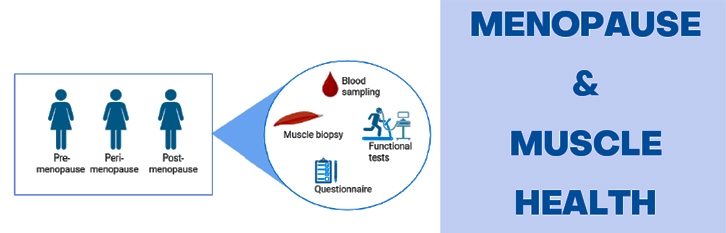 MENOPAUSE & MUSCLE HEALTH ; Invitation for Public Private Partnership (PPP) Duration: 24 months from Q1, 2027
Join our PPP to decode muscle remodeling across the menopausal stages and unlock targeted interventions for healthy muscle aging in women.
This PPP generates high-resolution, menopausal-phase stratified transcriptomic muscle data, a dataset that does not currently exist at scale. For industry, this closes a critical evidence gap that directly affects product efficacy, development risk, and market differentiation in midlife women.
In our new PPP, we will first generate transcriptomic profiles from muscle biopsies of pre-, peri-, and post-menopausal women to identify biomarkers, pathways, and intervention targets for healthy muscle aging.
Study phases:
・Build a muscle biopsy cohort across menopausal stages.
・Generate transcriptomic datasets and compare molecular signatures across menopausal stages.
・Identification of menopausal biomarkers, pathways and intervention targets.
・Optional: data -driven target identification through a validated in silico knock-out model.
・Optional: partner specific partner specific compounds / ingredient testing in in vitro muscle models.
Women experience a steep decline in muscle strength and metabolic flexibility around menopause. We previously found that muscle aging and weakness are not a linear process,
but are shaped by sex-specific differences,1,2, leaving scope for effective intervention before,
during, and after menopause 3. Despite this, most muscle research relies on male or mixed sex cohorts without menopausal stratification.
A detailed molecular characterization across the menopausal transition is needed to bridge the gap between basic research and actionable interventions.
This public private partnership shifts women’s muscle health from extrapolation to precision biology and allows industry partners to lead rather than follow.
References:
□
1. Sex differences in skeletal muscle-aging trajectory: same processes, but with a different ranking. De Jong JCBC, et al.Geroscience. 2023.
□
2. Evidence for sex-specific intramuscular changes associated to physical weakness in adults older than 75 years. De Jong JCBC, et al. Biol Sex Differ. 2023.
□
3. A Novel Low-Impact Resistance Exercise Program Increases Strength and Balance in Females Irrespective of Menopause Status. Svensen E, et al. Med Sci Sports Exerc. 2025.
Fibrosis models
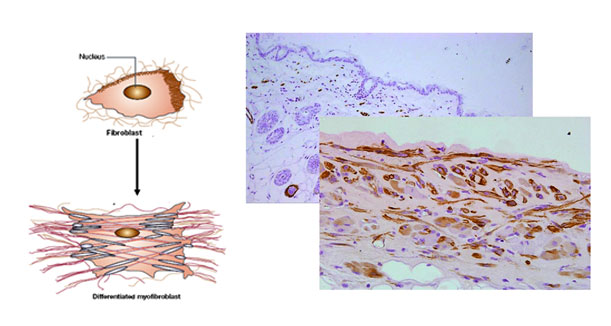
・Lung Bleomycin-induced lung fibrosis model in mice
(Feature:o.p.administration, low variation and motality)
・Skin Bleomycin-induced skin fibrosis model in mice.
・Liver CCL4-induced, Diet-induced model in mice
・Kidney UUO model in mice.
・in vitro fibrosis assay with the fibrosis patient samples
Myoblast differenciation, Fibroblast proliferation, Migration
Current co-development & collaboration opportunities
● Development of Novel Blood-Based Biomarkers for IPF
Recent publication: Targeting the Wnt signaling pathway through R-spondin 3 identifies an anti-fibrosis treatment strategy for multiple organs
We're open to discuss;
・Collagen type analysis:Collagen 1α1, 3α1, 4α1, 5α1, 6α2.
・Signatutre analysis involving newly synthetised collagen
Reference
□ Collagen quantification in cell cultures and tissues.
14C-Pulse-Chase Technology: translational and mechanistic evidence for drug efficacy.
Flux Analysis using 14C and AMS; De Novo Lipogenesis, Muscle Protein Turnover, etc
Standard metabolomics tells you what is present. Pulse-chase analysis tells you what is actually happening.
By combining 14C microtracers with Accelerator Mass Spectrometry, we quantify real-time biochemical pathway activity in vivo,
generating the mechanistic proof-of-concept data that plasma biomarkers and static metabolite snapshots cannot deliver.
Why static metabolomics is not enough?
The development of drug candidates targeting biochemical pathways runs into one fundamental problem: the gap between what a biomarker suggests and what the drug actually does in human metabolism.
Plasma values for lipids, glucose or liver show how much is present at a given moment, not how fast metabolic processes are running, which pathways are active, or where an intervention genuinely takes effect.
This distinction is not academic; drug candidates with promising static biomarker profiles regularly fail later because the mechanistic foundation was absent.
At the same time, IND packages are weakened by a lack of data on how a compound behaves in a human-relevant system at the point when course correction is still affordable: before Phase I.
Pulse-chase analysis addresses this directly. Rather than measuring what is present, we quantify the activity of specific pathways in a living system, in real time, by determining the turnover rate of a pathway probe.
What is AMS-based 14C-Pulse-Chase Technology?
Pulse-Chase Technology quantifies the rate at which metabolites flow through enzymatic networks in vivo. Where standard metabolomics provide a static picture, PCT delivers dynamic insight: which pathways are active, at what rate, and how do pharmacological interventions influence those pathways.
We use specifically 14C-labelled Pulse-Chase Technology (14C-PCT) in combination with Accelerator Mass Spectrometry, a detection technique capable of quantifying 14C-labelled compounds at attomole levels in biological samples. This enables us to administer doses of 14C-labelled probes at non-perturbing levels,
so called microtracer levels, whilst still generating reliable, quantitative data on pathway activity, tissue distribution rate and metabolic processing.
The result is direct, quantitative data on how a drug candidate influences the rate at which the probe is converted through its metabolic pathways in vivo in animal models, in man or for translational read-outs, in both.
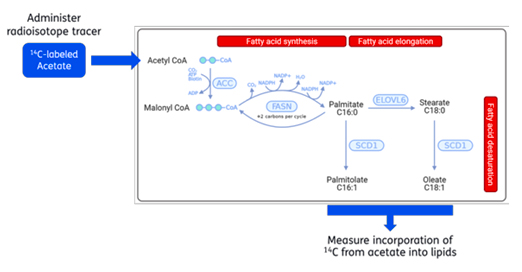 Application
● De Novo Lipogenesis (DNL)
● HDL funcitionality / Reverse Cholesterol Transport
● Muscle Protein Synthesis & Breakdown (combined 14C and D2O analysis)
● Glucose Metabolism (DNL, conversion to fluctose)
Technical info:
●
Flux Analysis using 14C and AMS
