
CKD/Cardiovascular-Kidney-Metabolic syndrome model (CKD+HFpEF)
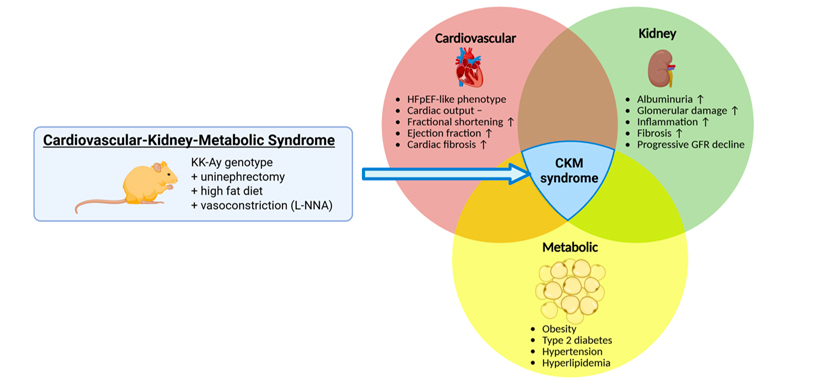
Cardiovascular-Kidney-Metabolic (CKM) Syndrome is a complex disorder involving CVD, kidney disease, type 2 diabetes and obesity.
These conditions share risk factors and can exacerbate each other. Development of new therapies is hampered by the lack of translational models.
TNO has developed a novel mouse model of CKM syndrome characterized by obesity, diabetes, and hypertension. This model develops diabetic to chronic kidney disease (DKD/CKD) and heart failure suggestion HFpEF.
This model reflects the human clinical condition, which enables comprehensive, mechanistic studies of CKM syndrome across both early and advanced stages.
Reference paper; Molecular Metabolism. Apr, 2026
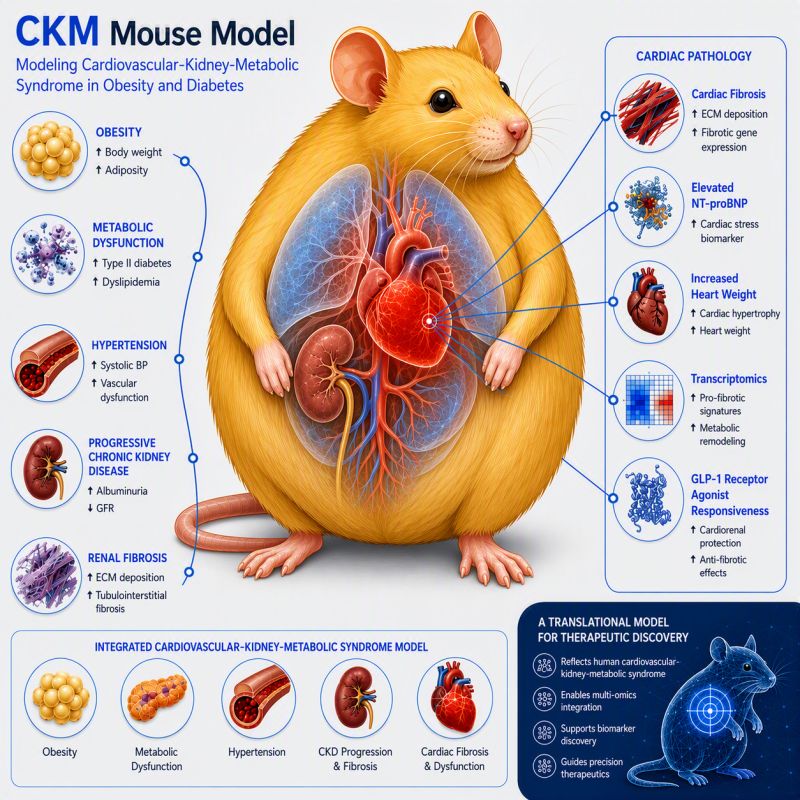
Heart disease in CKM is more than a biomarker: new data from TNO's multifactorial CKM model
TNO has expanded the characterization of our multifactorial CKM mouse model and generated new evidence showing significant cardiac involvement.
Additional to our previous data demonstrating increased ejection fraction, cardiac hypertrophy and decreased end systolic volume as published,
we further expanded the cardiac characterization of our CKM model and demonstrated:
● Increased heart weight and elevated NT-proBNP
● Cardiac fibrosis in both left and right ventricles
● Distinct cardiac transcriptomic changes associated with disease progression
● Significant reductions in cardiac fibrosis following GLP-1 receptor agonist treatment.
These results build upon the model's established characteristics, including obesity and metabolic dysfunction, progressive kidney disease and renal fibrosis, hypertension, cardiovascular pathology and translational response to SGLT2 inhibitors and GLP-1 receptor agonists.
As the CKM therapeutic landscape continues to evolve, drug developers increasingly require models that capture interactions across organ systems rather than isolated disease manifestations.
 An unexpected finding: pulmonary pathology in TNO's CKM model
CKM syndrome is often discussed through the lens of the heart, kidney, and metabolic system. However, growing clinical evidence suggests that pulmonary complications may also be part of the disease spectrum.
To better understand extra-renal and extra-cardiac comorbidities, we recently expanded the characterization of TNO's CKM mouse model to include the lungs. The literature shows that that 9% to 27% of long-term type 2 diabetes patients exhibit restrictive lung disease.
What we found was intriguing: Alveolar damage, increased macrophage accumulation, early fibrotic changes in lung tissue, pulmonary fibrosis-related signaling pathways identified through cardiac transcriptomics and improvement of lung pathology following GLP-1 receptor agonist treatment.
These findings further support the value of a model that combines obesity and metabolic dysfunction, hypertension, progressive chronic kidney disease, cardiac remodeling and fibrosis and multi-organ involvement across the CKM spectrum.
For researchers developing therapies aimed at fibrosis, cardiometabolic disease, or organ cross-talk, these additional pulmonary readouts may provide valuable translational insights.
Features of Cardiovascular-Kidney-Metabolic (CKM) syndrome model
・Obesity and type 2 diabetes as background of the model. Indicate that the model is diet-induced and hypertension-accelerated.
・Progressive decline in renal function in setting of hyperglycemia, typically preceded by a period of glomerular hyperfiltration.
・Quick onset of Albuminuria
・Pathological changes in kidneys:
> Glomerular basement membrane thickening
> Mesangial matrix expansion and sclerosis
> Tubulo-interstitial fibrosis
> Arteriolar hyalinosis
・Diet induced (Human-like diet composition)
・The model shows hyperlipidemia, hyperglycemia and hypertension, albuminuria, decline in GFR and typical histological features of DKD.
・The model also shows Coronary calcification, Myocardial fibrosis, HFpEF and HFrEF as observed in Heart Failure.
・Reference control: Combination of SLGT2i and GLP1ra.
Readout parameters
・Metabolic parameter: BW, F&W-intake, Glucose, Insulin, CHO, TG
・Function: Diuresis, Albuminuria, UACR, GFR by Transdermal FITC-sinistrin clearance
・Pathology: Quantitative scoring of Glomerular and Tubular damage, Liver and Lung damage
・Optional: Proteomics/Metabolomics,Next generation sequencing, EM microscopy, PEMP analysis (NIPOKA)
Download Publication
□
A novel mouse model for cardiovascular-kidney-metabolic syndrome: bridging metabolic, renal and cardiac dysfunction.
Molecular Metabolism. Apr, 2026
□
Treatment with Either SGLT2 Inhibitors or GLP-1 Receptor Agonists Rescues GFR Decline in a Multifactorial Cardiovascular-Kidney-Metabolic Syndrome Mouse Model. Journal of the American Society of Nephrology. Oct, 2025
□
Standard-of-care combination therapy rescues GFR decline and cardiac damage in a novel cardiovascular-kidney-metabolic syndrome mouse model
□
Combination therapy with Lisinopril and Dapagliflozin rescues GFR decline and glomerular damage in the advanced DKD/CKD KKAY mouse model.
□
Cardiac damage in DKD/CKD mouse model resembles HFpEF and can be reduced by Standard-of-care treatment.
